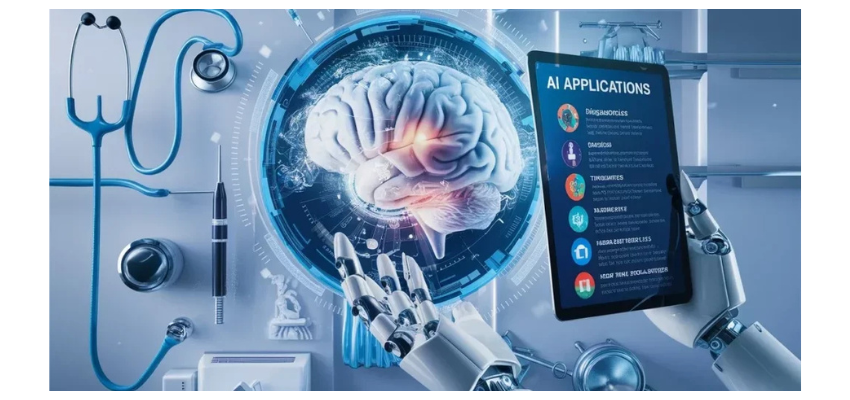

Artificial intelligence (AI) is rapidly becoming a foundational technology in modern healthcare systems. Rather than being a future concept, AI is already integrated into clinical workflows, medical imaging, hospital administration, drug development, and patient monitoring. Regulatory bodies such as the U.S. Food and Drug Administration (FDA) have already authorized hundreds of AI-enabled medical devices, particularly in imaging and diagnostics, reflecting the maturity of the field and its growing clinical adoption.
- 1. AI in medical imaging and diagnostics
- 2. AI-powered clinical decision support systems (CDSS)
- 3. Administrative automation and reducing clinician workload
- 4. AI in emergency medicine and real-time triage
- 5. AI in drug discovery and precision medicine
- 6. AI in remote patient monitoring and wearable health systems
- 7. AI in medical documentation and communication
- 8. Key challenges and risks in healthcare AI
- 9. The future: AI as a clinical partner, not a replacement
At the same time, healthcare systems are carefully balancing innovation with safety, regulation, and ethical concerns as AI becomes more deeply embedded in decision-making processes.
1. AI in medical imaging and diagnostics
One of the most established applications of AI in healthcare is medical imaging, especially in radiology, cardiology, and oncology.
AI systems are widely used to:
- Detect tumors in CT and MRI scans
- Identify fractures and abnormalities in X-rays
- Analyze mammography results for early breast cancer detection
- Assist in stroke detection and triage in emergency settings
The FDA has cleared a large number of AI-enabled imaging systems for clinical use, reflecting how deeply these tools are now embedded in diagnostic workflows.
In practice, these systems act as clinical decision support tools, highlighting suspicious regions in scans and prioritizing urgent cases. Importantly, they are typically used to assist radiologists rather than replace them.
Recent deployments also show AI improving workflow efficiency in hospitals, reducing time to diagnosis in high-volume imaging departments.
2. AI-powered clinical decision support systems (CDSS)
AI is increasingly used to support doctors in making clinical decisions through Clinical Decision Support Systems (CDSS).
These systems analyze:
- Patient medical history
- Lab results
- Imaging data
- Population-level clinical guidelines
They then provide recommendations such as:
- Possible diagnoses
- Suggested treatment pathways
- Risk predictions for disease progression
Recent research shows that advanced AI systems can achieve diagnostic performance comparable to experienced clinicians in controlled settings. For example, multi-agent AI systems have demonstrated high agreement with board-certified clinicians in diagnostic tasks, suggesting strong potential for future clinical integration.
However, experts emphasize that these systems must be carefully validated for safety, fairness, and explainability before being widely deployed in real-world environments.
3. Administrative automation and reducing clinician workload
A major but often overlooked application of AI in healthcare is administrative automation.
Healthcare professionals spend a significant portion of their time on non-clinical tasks such as documentation and reporting. AI helps reduce this burden by:
- Automatically generating clinical notes from doctor-patient conversations
- Summarizing medical records
- Handling billing and coding documentation
- Managing appointment scheduling and triage systems
This category of applications is one of the fastest-growing areas of healthcare AI, because it directly improves efficiency and reduces burnout among clinicians.
AI-driven medical documentation tools are already deployed in dozens of healthcare systems, particularly in the United States, where they are used to streamline electronic health record (EHR) workflows.
4. AI in emergency medicine and real-time triage
AI is increasingly used in emergency departments and urgent care settings, where speed is critical.
Applications include:
- Stroke detection from CT scans within minutes
- Prioritization of critical cases in radiology queues
- Early warning systems for sepsis and cardiac arrest
- Automated interpretation of vital signs in real time
These systems help clinicians identify high-risk patients faster, improving survival rates in time-sensitive conditions.
AI-based triage tools are especially valuable in hospitals with high patient volume, where manual prioritization can delay urgent care.
5. AI in drug discovery and precision medicine
AI is transforming pharmaceutical research by accelerating drug discovery and molecular analysis.
Key applications include:
- Predicting protein structures and molecular interactions
- Identifying potential drug candidates
- Simulating clinical trial outcomes
- Designing personalized treatment strategies
AI significantly reduces the time required to screen compounds compared to traditional laboratory methods, allowing researchers to focus on the most promising candidates earlier in the pipeline.
In precision medicine, AI is used to tailor treatments based on a patient’s genetic profile, lifestyle, and medical history, improving treatment effectiveness and reducing side effects.
6. AI in remote patient monitoring and wearable health systems
The expansion of wearable devices and remote monitoring tools has created new opportunities for AI in continuous healthcare.
AI systems are used to:
- Monitor heart rhythms for arrhythmias
- Detect abnormal glucose levels in diabetes patients
- Track sleep disorders and respiratory conditions
- Provide early alerts for deteriorating health conditions
These systems enable continuous, real-time healthcare outside of hospitals, shifting medicine toward preventive care rather than reactive treatment.
7. AI in medical documentation and communication
Natural language processing (NLP) is widely used in healthcare to improve communication and documentation.
Applications include:
- Transcribing doctor-patient conversations
- Generating structured clinical notes
- Summarizing medical histories
- Supporting multilingual communication in hospitals
These tools are especially important in reducing administrative workload and improving the consistency of medical records.
8. Key challenges and risks in healthcare AI
Despite rapid progress, several challenges remain critical:
Safety and validation
Many AI tools still require rigorous clinical validation before widespread deployment. Some studies suggest that a significant proportion of healthcare AI tools lack strong real-world validation, raising concerns about reliability in clinical environments.
Bias and fairness
AI systems trained on biased datasets may produce unequal outcomes across different populations, potentially worsening healthcare disparities.
Explainability
Clinicians must understand how AI systems arrive at recommendations. “Black-box” models remain a major barrier to trust and adoption.
Data privacy
Healthcare AI depends on sensitive patient data, requiring strict compliance with privacy regulations such as HIPAA and GDPR.
9. The future: AI as a clinical partner, not a replacement
Current evidence suggests that AI is not replacing healthcare professionals but rather acting as a decision-support and augmentation tool.
In many modern systems:
- Doctors remain responsible for final decisions
- AI provides recommendations and pattern recognition
- Human oversight ensures safety and accountability
At the same time, experimental systems are already showing that AI can match or even exceed human performance in specific diagnostic tasks under controlled conditions.
Artificial intelligence is now deeply embedded in modern healthcare systems, with applications ranging from diagnostic imaging and clinical decision support to administrative automation and drug discovery. Regulatory approval of AI-enabled medical devices and increasing clinical adoption demonstrate that the technology is already part of mainstream medicine.
However, the integration of AI in healthcare is still evolving. The key challenge is not whether AI can be used, but how it can be deployed safely, ethically, and effectively while maintaining human oversight and patient trust.
The future of healthcare will likely be defined by human-AI collaboration, where intelligent systems enhance medical expertise rather than replace it.