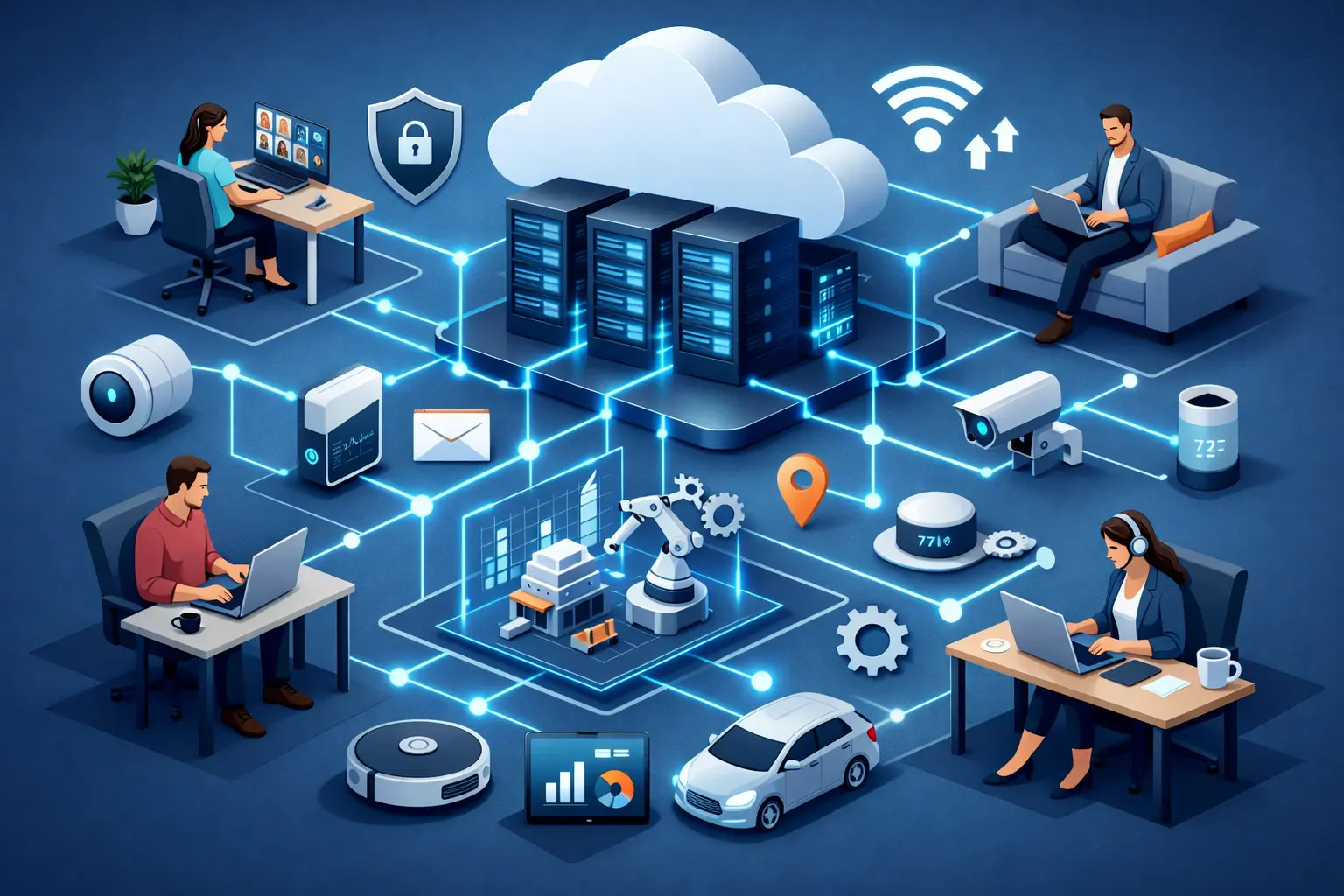

Cybersecurity in 2026 is undergoing one of its fastest transformations in decades. Driven by the widespread adoption of artificial intelligence, increasing regulatory pressure, and the rise of identity-centric attacks, enterprises are fundamentally reshaping how they protect data and manage digital risk. Instead of relying on perimeter-based defenses, organizations are moving toward continuous verification, zero trust architectures, AI-driven security operations, and automated data protection systems.
- 1. AI is reshaping both attacks and defense strategies
- 2. The rise of Zero Trust as a default enterprise model
- 3. Identity is now the primary security perimeter
- 4. Ransomware and identity-based attacks are evolving
- 5. Data protection is shifting toward encryption, immutability, and recovery resilience
- 6. AI-driven data security and governance automation
- 7. Regulatory pressure is reshaping cybersecurity strategy
- 8. Emerging challenges: AI agents and autonomous systems
1. AI is reshaping both attacks and defense strategies
Artificial intelligence has become the central force influencing cybersecurity evolution. According to the World Economic Forum’s Global Cybersecurity Outlook 2026, AI is widely considered the most significant driver of change in cybersecurity, affecting both attackers and defenders simultaneously.
On the defensive side, organizations are increasingly using AI to:
- Detect phishing and social engineering attempts
- Analyze large-scale security logs in real time
- Automate incident response workflows
- Identify anomalies in network behavior
A large share of enterprises—around 77% according to industry surveys—already use AI in cybersecurity operations.
However, AI is also expanding the threat landscape. Security experts report that generative AI and autonomous agents are increasingly used to enhance phishing, reconnaissance, and automated exploitation. In some documented cases, AI systems have been used across the full attack lifecycle, from scanning targets to exfiltrating data.
This dual-use nature of AI has become one of the defining cybersecurity challenges of 2026.
2. The rise of Zero Trust as a default enterprise model
One of the most important architectural shifts in enterprise cybersecurity is the widespread adoption of Zero Trust Architecture (ZTA).
Zero Trust is based on a simple principle: never trust, always verify. Instead of assuming users or devices inside a network are safe, every access request is continuously authenticated and validated.
Recent implementations of Zero Trust now include:
- Continuous identity verification
- Least-privilege access control
- Micro-segmentation of networks
- Strong authentication (including passkeys and phishing-resistant MFA)
According to cybersecurity trend analyses, Zero Trust identity systems and passkeys are becoming standard across critical enterprise environments in 2026.
A major evolution in this space is the extension of Zero Trust principles to machine identities and AI agents, which now often outnumber human identities in enterprise systems.
3. Identity is now the primary security perimeter
A major shift in cybersecurity is the move from network-based security to identity-centric security.
Modern enterprises face a rapidly expanding identity landscape that includes:
- Human users
- Cloud service accounts
- APIs and machine identities
- Autonomous AI agents
Research shows that machine identities are now growing faster than human identities, creating a “human-machine identity blur” where traditional access models are no longer sufficient.
This has led to new security strategies such as:
- Unified identity governance frameworks
- Continuous authentication systems
- Behavior-based identity monitoring
- Automated credential lifecycle management
The core idea is that every identity—human or non-human—must be continuously verified and monitored.
4. Ransomware and identity-based attacks are evolving
Ransomware remains one of the most damaging cyber threats, but its methods have evolved significantly.
Key trends include:
- Increased use of stolen credentials instead of brute-force attacks
- Targeting of cloud infrastructure and identity systems
- Faster exploitation of vulnerabilities (sometimes within hours of disclosure)
- Integration of AI tools into phishing and social engineering campaigns
Modern attackers often “log in instead of breaking in,” exploiting weak authentication systems rather than technical vulnerabilities.
This shift has made identity security and credential protection the primary defense layer for many organizations.
5. Data protection is shifting toward encryption, immutability, and recovery resilience
Enterprise data protection strategies are also evolving beyond traditional backup systems.
In 2026, organizations are prioritizing:
Immutable backups
Backups that cannot be altered or deleted, even by attackers, are now widely adopted to counter ransomware encryption attempts.
The 3-2-1 backup strategy
Many organizations continue to implement the principle of:
- 3 copies of data
- 2 different storage types
- 1 copy stored off-site
This remains a foundational resilience model in enterprise environments.
Encryption-first architectures
Data is increasingly protected using:
- End-to-end encryption
- Key management systems (KMS)
- Confidential computing environments
These methods ensure that even if attackers gain access to infrastructure, data remains unreadable.
6. AI-driven data security and governance automation
Another major development is the use of AI to automate data governance and compliance enforcement.
Enterprises are now using AI systems to:
- Classify sensitive data automatically
- Detect data leakage risks in real time
- Monitor cross-cloud data movement
- Enforce regulatory compliance policies
However, this introduces new risks. According to cybersecurity research, a growing percentage of organizations report that AI systems themselves can introduce data leakage and compliance challenges, especially when not properly governed.
This has led to increased demand for:
- AI auditing frameworks
- Model access controls
- Data provenance tracking
7. Regulatory pressure is reshaping cybersecurity strategy
Cybersecurity is no longer just a technical concern—it is now a governance and legal priority.
New global regulations such as:
- EU NIS2 Directive
- DORA (Digital Operational Resilience Act)
- SEC cyber disclosure rules
- EU AI Act
are forcing organizations to:
- Report incidents faster
- Maintain stronger audit trails
- Assign executive-level cyber accountability
- Integrate compliance into system design
Recent industry analysis highlights that cybersecurity has become a board-level governance issue rather than an IT-only responsibility.
8. Emerging challenges: AI agents and autonomous systems
One of the newest risks in enterprise cybersecurity is the rise of autonomous AI agents.
These systems can:
- Execute API calls
- Make decisions without human intervention
- Access enterprise systems and workflows
While they improve efficiency, they also introduce risks such as:
- Excessive privilege accumulation
- Prompt injection attacks
- Unauthorized system actions
- Difficulty in auditing decisions
Security experts now emphasize the need for strict identity control and continuous monitoring of AI agents, treating them as active participants in enterprise networks rather than passive tools.
Cybersecurity and enterprise data protection in 2026 are defined by a major structural shift: from perimeter-based defense to identity-centric, AI-driven, and continuously monitored security systems.
Key takeaways include:
- AI is both the strongest defense tool and one of the fastest-growing threat vectors
- Zero Trust architectures are becoming the default enterprise model
- Identity has replaced the network as the primary security boundary
- Ransomware and cybercrime are increasingly credential-driven
- Data protection now relies on encryption, immutability, and automated recovery
- Regulation is turning cybersecurity into a governance discipline
- AI agents introduce a new category of security risk
Overall, organizations are no longer just protecting systems—they are building self-defending, adaptive security ecosystems capable of responding in real time to evolving threats.